


Machine Translation or Professional Translation?
When to Trust DeepL (and When Not To)
DeepL translates a contract in a matter of seconds. Google Translate supports 133 languages. Machine translation engines have become powerful, accessible, and—in many cases—remarkably accurate tools.
So why do professional human translators still exist?
The answer is less obvious than it might seem.
What Machine Translation Does Well
Let’s look at the facts: modern neural machine translation systems have made massive strides in recent years. For certain types of content, the results are genuinely good.
Where machine translation works:
- Informal emails and internal team communications
- Quickly grasping the general sense of a foreign document
- Short, repetitive texts with simple sentence structures
- First draft generation intended for subsequent post-editing
- Low-stakes, short-lived content with limited circulation
If you need to understand the general meaning of a foreign document or write a quick email to a supplier, DeepL gets the job done. Nobody denies that.
Where Machine Translation Fails — and Why It Matters
The problem isn’t that machine translation is bad. The problem is that it doesn’t know when it’s making a mistake.
A human translator who encounters an ambiguous term pauses, verifies, and asks for clarification if necessary. A neural engine always generates an output—even when the source text is ambiguous, technical, idiomatic, or culturally sensitive. And it does so with the exact same level of confidence as when translating an elementary phrase.
Critical high-risk scenarios for businesses:
Technical and legal terminology: Every sector relies on a precise lexicon. In legal contexts, terms like “lease,” “loan for use,” or “usufruct” carry distinct, non-overlapping legal definitions—and an inaccurate translation can completely distort the intent of a contractual clause. Neural engines tend to select the most common term, not the most accurate one for the specific context.
Medical and scientific texts: An error in a medical record or drug package insert is not a typo—it is a tangible, real-world risk. Terminological accuracy in healthcare is non-negotiable.
Marketing and brand communications: Machine translation fails to grasp irony, wordplay, cultural nuances, or a brand’s specific tone of voice. An automatically translated ad campaign always reads like a translation—and consumers notice immediately.
Morphologically complex languages: Languages such as Arabic, Japanese, Finnish, or Hungarian feature grammatical structures vastly different from Western European languages, causing error margins to increase significantly.
Documents with legal standing and sworn translations: Contracts, notary deeds, certificates, court rulings—any document producing legal effects requires a sworn or certified translation by a qualified professional. Machine translation holds zero legal weight in any jurisdiction.
Post-Editing: The Best of Both Worlds
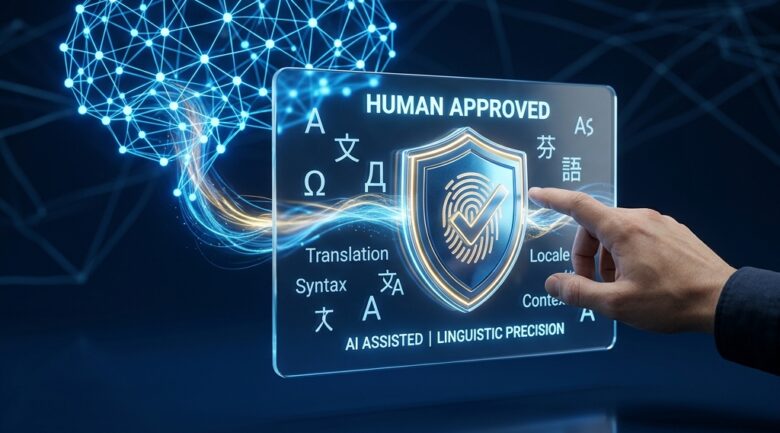
There is a middle ground that an increasing number of companies are adopting: Machine Translation Post-Editing (PEMT).
The document is first translated by a neural engine, then reviewed and revised by a specialized native-speaker translator. The result is a professional-grade translation delivered with faster turnarounds and lower costs than full human translation.
It is the right choice when:
- Text volumes are high and deadlines are tight
- Budgets are constrained while quality remains a priority
- Content is predominantly technical and repetitive
- Engines pre-trained on domain-specific glossaries are used
It is not the right choice for high-stakes legal, medical, or creative content, where human editing cannot compensate for structural flaws in raw automated output.
The Rule of Thumb for Your Business
A simple question to guide your choice:
What would be the real-world consequence of an error in this translation?
- No significant consequence → machine translation may suffice
- Moderate consequences → consider professional post-editing (PEMT)
- Legal, medical, reputational, or commercial risks → professional human translation, zero exceptions
Conclusion and Professional Support
Machine translation is a useful tool—not a replacement for a professional translator. Like any tool, it must be used in the right context with a full understanding of its limitations.
If you are unsure which approach best suits your project, Polyline Translations offers a free evaluation: we analyze your documentation and provide an honest assessment of whether post-editing fits your needs or if your project requires a full professional translation.


 © 2026 Polyline. All rights reserved.
